
The Simple Slushy Calculator. You guys know how much I hate the gatekeeping that happens from time to time in this industry. Believe it or not, there are bartenders out there who would rather die than help other people make great drinks. It sucks.
What also sucks is that sometimes we bartenders just do what we do by feel, and would have a really hard time explaining to someone how to do it themselves. Making a slushy has always been like that for me. I can make a great one, I even know one of the magic numbers that you need to hit in order to get there, and yet I still couldn’t quantify how you can do it yourself, because there are so many moving pieces.
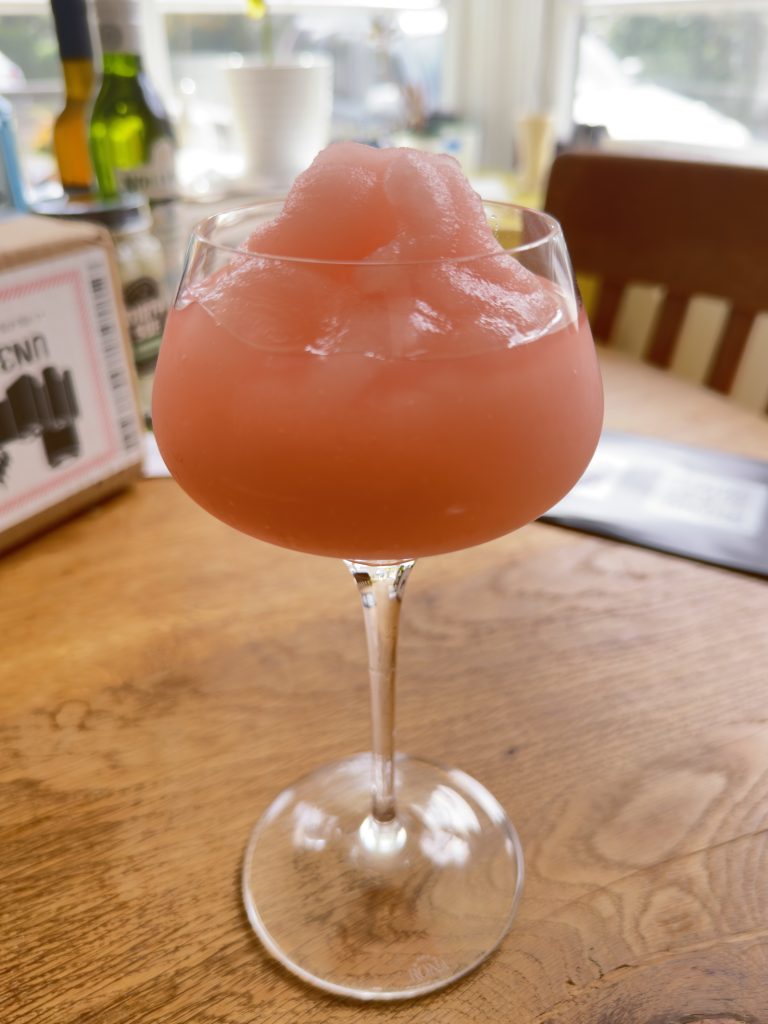
First off, not every cocktail is a candidate for being great in the frozen drink machine. Cocktails that taste great in slushy form are – and I don’t know how better to describe this, but – juicy. Like, a Martini isn’t going to be a good slushy. A Negroni isn’t a good slushy unless you add some sort of juice to it, like orange or grapefruit perhaps (Tangerine? Pomelo? Now I’m getting thirsty.) Even if they’ve got some juice in there, they might not yet be right: I love a perfectly-prepared Pegu Club but even without looking at the recipe I can tell you that it’s too stiff and dry for the machine.
But it’s also got to be something you can throw a bunch of extra sugar at, without crushing the overall vibe/feeling/character of the drink. Sugar is – and I know this is going to get a bunch of comments from the diet people and the alternative sweetener people and the xanthan gum people – absolutely essential to giving a drink that nostalgic and pleasant texture – and mouthfeel – that guests want from a slushy. Slushy drinks aren’t too sweet – they’re perfectly sweet. I’ve tried the hacks and the substitutions and nothing will scratch that frozen drink nostalgia itch like 13.5% brix. And besides, you’re serving this thing at twentysometing degrees. The sugar is heavily, heavily muted.
I’ve looked at a lot of formulas and watched a lot of videos out there, and even I was confused. So the challenge for myself became: how do I make a simple slushy calculator that serves both the casual drink-maker and the professional bartender? And where I landed was a system with built-in guardrails that would get you to the correct slushy consistency we’re looking for, every time. Can this calculator look at your recipe and say, “This isn’t going to taste great”, or “This sounds really good.”? No, no calculator can do that. But again, what this will do is take your already-delicious drink and make it work in your machine.
It starts with the recipe. You’ve l enter everything in there, with the correct ABV for each ingredient. Alcohol content is crucial to slushy texture, and our goal here is to get that drink down to 9% ABV or below. Throw a 25%+ ABV cocktail at the calculator and it’s going to send you back to the drawing board (and basically tell you to go figure out how to throw some juice in there.)
Then, you’re going to have to make a single serving of the drink. Don’t chill it, don’t shake it, don’t stir it, don’t dilute it. Just throw those ingredients in a glass, and give them a good stir. The calculator needs you to take an inexpensive optical refractometer and measure the initial Brix (sugar content) of your drink. You can’t skip this part, and I can’t program a calculator that intuitively knows the sugar content of literally every liquid on earth. So this is how we make this work. You’re also going to let the calculator know what syrup ratio you use: 1:1 or 2:1. No, there are no other options (these are the two industry-standard syrup ratios) and I’m sorry but it was just getting too complicated trying to accommodate your weird housemade 3:2 syrup. 🤣 Anyway, if you’re having trouble making a perfect 1:1 or 2:1 I of course have you covered for that as well.

Alcohol content throws off refractometer readings, so the calculator works behind the scenes to compensate for your drink’s ABV and determine – as close as possible – the actual sugar content of your cocktail. Pretty nifty.
The rest of the process is really easy: Enter the volume of batch you’re looking to make. Our slushy machine at the bar holds ton, so we make drinks in five-gallon buckets. My Ninja Slushi at home holds a half-gallon, which is just fine for our small backyard gatherings. A nice optional feature I tacked on there was to ask you your serving size, so you can estimate how many drinks you’re going to get out of this volume (since frozen drink machines are volume-based and not number-of-servings-based, it didn’t make sense to scale up for number of servings like I did with the Batch Cocktail Calculator)
And that’s all you have to do on your end. Behind the scenes, the calculator is running two formulas at essentially the same time: bringing your drink down below 9% by using dilution (water) and bringing the Brix up or down to 13.5%. Once that’s achieved, your results are presented clearly on screen, or as a beautifully-formatted print edition that you can of course print or save as a PDF. You’ll see that in addition to your scaled recipe there will also likely be any additional required water or simple syrup.

And that’s it! I really hope that you get some use out of it this spring, summer, and beyond. I’m constantly tweaking and perfecting these calculators based on any pertinent feedback I get on them, and of course be on the lookout for this calculator coming soon to the Bevnap app, where you will be able to store that Brix data in each cocktail, save your ingredients with ABV, and of course save your scaled, perfect slushy recipes and share them in any format you need.

Just curious about the formula your calculator uses behind the scenes to isolate sugar from ABV. I’ve been interested in sugar content of liqueurs for quite some time, not for dietary reasons, but for cocktail math. I’ve tried (and failed) many times to get a formula that works based on brewing and winemaking. Would be awesome if you could share!
Hey Oliver! The app isolates the sugar’s Brix by removing alcohol’s contribution to the refractometer reading — ABV is an input in the form, so not something we have to solve for. The refractometer converts refractive index to Brix assuming sugar is the only solute; but ethanol has a higher refractive index than water, so it adds “phantom” Brix and inflates the reading. We subtract it back out: trueBrix = reading − (k × ABV). The best-documented experimental value for k that we found is James Gossett’s (~0.35 Brix per %ABV). Our tool runs a smaller coefficient that I’ve bench-tuned to my own instrument and drink range, so treat it as a house calibration rather than a physical constant.
Hi Jeff!
Further testing proved your original theory correct. I did full 64oz batches in a Vitamix Blender using the weight in ice instead of water from the calculator and it was perfect. I think I must have done something wrong the first time. 😐
This will work for me until I get that Ninja Slushi. 🙂
Thanks again!
That’s awesome, Dawn! Thanks for letting us all know!
Hi Jeff,
I did one small batch substituting ice for water by weight. The consistency was too watery and I needed to add about 200 more grams of ice than the calculator called for. (It was still delicious) For reference, the calculator called for 362ml/g of water but I used around 562 grams of ice. I’m going to do a larger batch this weekend and will be more precise with the measurments and let you know how it turns out. 🙂
Thanks for responding, Dawn! That’s great information – I think you’ve inspired me to try some test of my own to see if I can come up with a loose formula that works for blenders. Interested to hear how the larger batch goes!
I love this and thank you for it! 🙂 Extremely skilled and knowledgeable combined with extremely open and generous is such a rare thing!
I have one question. If I’m using a regular blender, how much ice vs water should be used?
Dawn, thank you for the kind words and it is absolutely my pleasure. I also have the same question and I’m so sorry I haven’t tested this part out yet. But here’s what I think will worked, just based on my many years working the blender station in several restaurant bars:
I want you to, first and foremost, make sure that all of your ingredients are chilled, like cold cold, in the fridge. Then, after running the calculator, use ice for where it calls for additional water. The calculator spits out fluid ounces and milliliters, but you can substitute ounces (by weight) and grams – evenly (16 fluid ounces of water = 16 ounces by weight of ice). I find that cracked/crushed/pebble ice works much better than giant cubes, especially if you don’t have a commercial blender.
That should work, but I would really appreciate it if you wouldn’t mind sharing your results here when you try this!
👑👑👑👑
This is EXACTLY what I needed right now! My Ninja arrived this week and I’ve been wondering what I was going to make. I’m going to try for a version of your amaretto sour this weekend, without the egg white
Thank you jeffrey!!!